
GILSONS

Updated: Jun 26
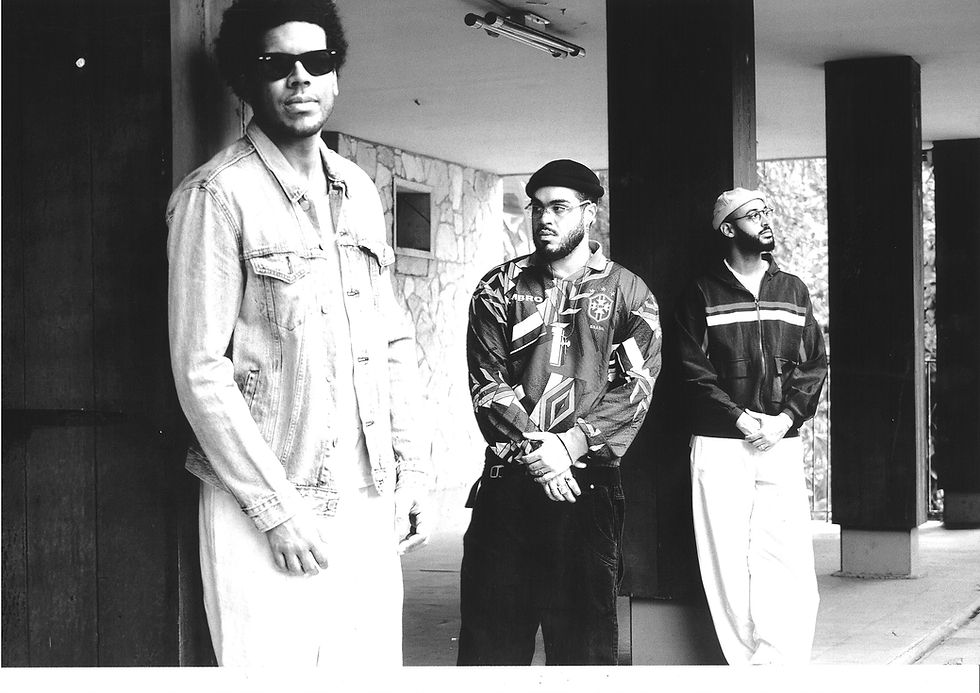
Presence, Happiness, Love and Family Connection
There are artists you admire, and then there are artists who quietly change the way you live. Gilsons are that for me. A Brazilian bossa nova group formed by the son, José Gil, and grandsons, Francisco and João Gil, of the legendary Gilberto Gil. They blend MPB, samba, Bahian rhythms, and contemporary pop into something that feels sunlit, warm, calming and also deeply alive. Writing about them feels personal, their songs have become a part of my everyday life playing in my headphones on the London Underground, or playing in open-air bars next to Copacabana beach in Rio. Their music has shaped the way I see life and love.
Interview by Sabrina Ciauri Portraits by Vinicius Rocha
In a world that constantly pushes for speed, noise, more reaction, their music feels like an invitation to be present. They create the space and openness to notice and feel what’s actually happening around you from the small details, the mood of a moment or the sound of the waves lapping against the shore. When I asked Francisco Gil what they hope listeners feel when they hear their music, his answer explained everything: "What I think is most interesting about music is the possibility of provoking diverse feelings, very personal connections. It's not a specific feeling but rather this possibility that they feel, and that it be from a deep place. It's the most beautiful thing when we hear from someone who connects and who lived a story and that song is related to that story." I am sure we all have that one song where a lived experience or memory lingers, refusing to let go. For Gilsons, this isn't accidental, their artistry is based on openness, creating music that weaves itself into our lives and memories and holds space for both the intensity and the calm.

That openness of their music is what first drew me in. For seven years, I've been dating a Brazilian, and Gilsons became the soundtrack to understanding what that means. Brazilian culture holds something essential about how to live: presence, being exactly where you are, not lost in yesterday or tomorrow. My favourite song, "Cores e Nomes," captures this: “Se num segundo tudo parar / É preciso olhar a volta.” If in a second everything stops, you have to look around. For me this represents an awareness of not letting life pass right before your eyes, but looking around at where you are, who is beside you and your feelings and appreciating and expressing those things while they are there.
José described how their music moves through people's lives: "We gained recognition for being music that is light to listen to, that brings reflections. You can listen to it at various moments of your day. People wake up listening to Gilsons, go to sleep listening to Gilsons, listen to work, to do sports. We're very happy to see that the music moves through various environments, in various situations."
That word he uses “light” or “leveza” carries a deeper meaning in Brazilian culture. It’s not about ignoring difficulty but choosing to samba or play volleyball on the beach even at dark moments. To meet life with some looseness and let go of some of the weight, to carry a softness in your step even when things get complicated. João expanded on where their lyrics come from: "We end up being inspired by many things in life, contemporary artists, our friends. Sometimes when we're sad,
sometimes when we're happy, all of this influences and inspires us. It's being able to actually capture this feeling and transform it into music somehow, being able to capture all these nuances of life and transform this into musicality." You can hear this in their songs, nothing feels emotionally distant. The music makes you feel alive with a special authenticity.

Carrying Gilberto Gil's extraordinary legacy, their approach is collaborative and experimental. José spoke about his father's influence: "My father inspires us a lot in the thing of experimentation and keeping up with the times. Throughout his career, he was including everything in his work. When he deeply discovered Reggae, he started making Reggae works. In his formation there was very strongly forró, baião. All this diversity and experimentation that he had in his career, we try to bring to
ourselves. Since we are three, we work more at an intersection of this movement." Seeing them perform at the Barbican Centre in London during their tour brought all of this into focus. Watching three family members together, so relaxed on stage with their voices and instruments blending. José had spoken honestly about performing: "There are days when this magic happens. We always seek this magic of emotion and music overflowing into incredible feelings there on stage. But there's also a
natural human variation. When you're on long tours, you find yourself having to face the stage as a craft, as work itself." But then he continued: "In other moments it's very natural, a catharsis, something very incredible, a union of us three there on stage with the band and the audience. Days when we take full advantage of everything that art has to offer."

That night at the Barbican was definitely this catharsis. João described what he looks for in those moments: "When there's this synergy between the audience and the band, when the whole crowd in front is moving in the same pulse and singing the lyrics, the melodies. When this junction happens, audience-band, band-audience, that's when it becomes special."
In all honesty their concert brought me to tears, not of sadness but from gratitude that I get to experience this life and this culture, that this music exists, that I was there witnessing this family creating something so open and alive together. The authenticity struck a chord.
This interview is inside The MUSIC Issue 16. Purchase your copy here.


Comments